
Aaron Hernandez Boyfriend: Shayanna Jenkins-hernandez Facts
Public attention surrounding Aaron Hernandez has long included questions about his private relationships, particularly claims that he may have had male romantic partners.
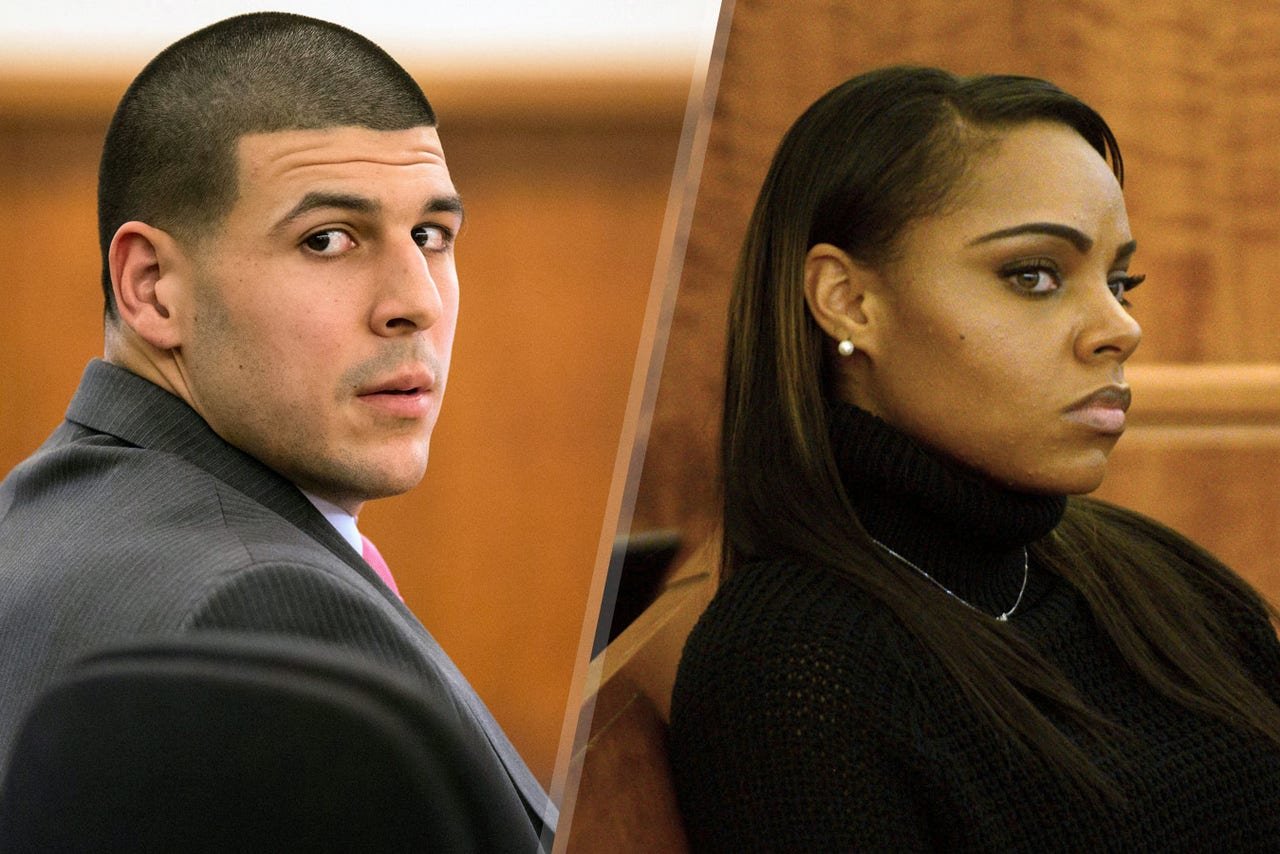
Did Aaron Hernandez Have a Boyfriend?
The public record does not establish that Aaron Hernandez had a confirmed boyfriend. He was engaged to Shayanna Jenkins-Hernandez, with whom he shared a daughter, at the time of his death. Claims of relationships with men have been made by individuals who knew him at different points in his life, but Hernandez never publicly confirmed a boyfriend or publicly defined his sexuality.
The strongest reporting on the subject distinguishes between documented facts and later personal accounts. Hernandez’s engagement to Shayanna Jenkins-Hernandez was public, and their relationship was an established part of his adult life. They had known each other since their youth, became parents, and remained connected throughout the criminal proceedings that dominated the final period of his life. Her status as his fiancée was broadly reported and was not in dispute.
Separate allegations involving men emerged after Hernandez’s death and have received substantial media attention. Dennis SanSoucie, a former friend and football teammate, stated publicly that he and Hernandez had a sexual relationship when they were teenagers. SanSoucie’s account provided a personal perspective on Hernandez’s early life, but it remained an allegation based on his own recollection. Hernandez was no longer alive to address, confirm, deny, or further explain the claim.
Another man, Kyle Kennedy, later described an alleged sexual relationship with Hernandez during his incarceration. Kennedy’s account appeared in televised programming and subsequent coverage. Like SanSoucie’s statements, it became part of the broader public discussion of Hernandez’s private life without creating a definitive public record of how Hernandez identified himself. A claimed relationship, even if accurately described by the person making the claim, does not necessarily establish a person’s sexual orientation or the complete nature of their personal life.
Shayanna Jenkins-Hernandez addressed speculation after a documentary series renewed scrutiny of Hernandez’s sexuality. She indicated that she had not observed conduct during their relationship that led her to believe he was concealing a different life from her. Her comments represented her experience as his fiancée rather than a final answer to all allegations about his past. The available evidence therefore supports a careful conclusion: Hernandez had a publicly known fiancée, while claims of male partners remain unconfirmed by Hernandez himself.
Shayanna Jenkins-hernandez Was Aaron Hernandez’s Fiancée
Shayanna Jenkins-Hernandez was the central confirmed romantic partner in Aaron Hernandez’s public life. The pair had a long personal history that preceded his fame in professional football. Their relationship developed from a shared community background into an adult partnership marked by family responsibilities, public attention, and extraordinary legal pressure.
They became engaged and had a daughter together. Their engagement remained in place while Hernandez faced criminal accusations, trial proceedings, and imprisonment. Jenkins-Hernandez appeared in court during major stages of the case and continued to be identified in reporting as his fiancée. Their relationship was therefore not merely a past association but an active family connection during the period immediately before his death.
Her position in the public narrative became especially complicated because of the overlap between the relationship and the investigation into the death of Odin Lloyd. Lloyd had a personal connection to Jenkins-Hernandez’s family, adding a painful dimension to an already closely scrutinized case. Jenkins-Hernandez was later charged with perjury in relation to the investigation, a case that was ultimately resolved without a conviction after Hernandez’s death. The legal proceedings did not establish that she participated in Lloyd’s killing.
In later public comments, Jenkins-Hernandez emphasized the version of Hernandez she knew as a partner and father. She did not present herself as having complete knowledge of every part of his past, but she rejected the idea that his sexuality had been obvious to her during their relationship. That distinction matters when assessing the public record. Her experience provides insight into their household and engagement, but it cannot independently verify or disprove claims from people who knew Hernandez in other settings.
Dennis Sansoucie’s Account of Their Teen Years
Dennis SanSoucie became one of the most prominent sources behind claims that Hernandez had a male relationship before his professional football career. SanSoucie had known Hernandez as a teenager in Connecticut, where both played football. He later said that their friendship included a sexual relationship and that the two had maintained a closeness that went beyond ordinary teammates or friends.
His account was presented years after the events he described and after Hernandez’s death. It could not be tested through a response from Hernandez, and no comprehensive independent record has publicly confirmed all of its details. Still, the allegation was significant because SanSoucie identified himself as someone from Hernandez’s early social circle rather than as a distant observer.
Reporting and documentary treatment of the allegation also placed it in the context of the pressure often associated with masculinity, elite athletics, and public image. Those themes may help explain why individuals can choose privacy around intimate matters, but they should not be used to presume facts that Hernandez did not state himself. The existence of a claim does not make it appropriate to assign a sexual identity with certainty.
The most responsible reading of SanSoucie’s account is that it is a notable, firsthand allegation about Hernandez’s adolescence. It contributes to the historical record of what has been said about him, while remaining distinct from verified confirmation by Hernandez. It also does not negate his established relationship with Jenkins-Hernandez. Human relationships and identity can be complex, and public labels can be less precise than the reality of an individual’s private life.
Claims Concerning His Time in Prison
Kyle Kennedy’s statements brought further attention to Hernandez’s personal life after his incarceration. Kennedy said that he shared a cell with Hernandez at the Souza-Baranowski Correctional Center and that the two were romantically and sexually involved. He portrayed their relationship as emotionally close during a difficult period in Hernandez’s life.
These allegations were reported after Hernandez had died by suicide in prison. Because Hernandez could not answer the claims, the information has remained dependent on Kennedy’s account and the manner in which it was presented by television and entertainment outlets. Public reporting did not produce a definitive, independently verified account of the alleged relationship.
Prison relationships also require particular caution in public discussion. Correctional settings are highly restrictive, records are often limited, and personal accounts may be difficult to corroborate. That does not automatically mean Kennedy’s statements were false, but it does mean the claims should be described accurately as allegations rather than settled fact.
The allegations have sometimes been treated as proof of a single conclusion about Hernandez’s sexuality. That approach goes beyond what the public evidence can support. A person’s sexuality is a matter of self-identification and personal history, not something conclusively determined by rumor, one allegation, a relationship history, or a public narrative constructed after death.
What is Known About Aaron Hernandez’s Private Life
Aaron Hernandez’s life has been examined through several overlapping lenses: his football career, violent criminal conduct, family background, legal cases, mental health questions, and posthumous brain research. His private relationships became another area of intense scrutiny because of the contrast between his highly masculine public image and the later claims about men in his life.
What is firmly established is that Hernandez played professional football, was engaged to Shayanna Jenkins-Hernandez, and was the father of her child. It is also established that he was convicted of the murder of Odin Lloyd and later died in prison. His death led to posthumous examination of his brain, which found severe chronic traumatic encephalopathy, commonly known as CTE.
CTE has been associated with repeated head trauma and can be linked to changes in mood, impulse control, cognition, and behavior. However, medical findings cannot provide a simple explanation for Hernandez’s actions, criminal conduct, intimate relationships, or sexuality. Experts generally caution against treating CTE as a complete answer to the complex personal, social, and psychological factors involved in any individual case.
Equally, allegations about male relationships should not be framed as an explanation for violence. There is no factual basis for suggesting that sexual orientation or private romantic conflict caused Hernandez’s crimes. The murder of Odin Lloyd was a grave criminal act, and the legal record should not be obscured by speculative attempts to connect unrelated aspects of Hernandez’s life.
Why Precision Matters When Discussing His Sexuality
Questions about whether Hernandez had a boyfriend can be answered most accurately by separating confirmed relationships from personal allegations. Shayanna Jenkins-Hernandez was his confirmed fiancée. Dennis SanSoucie and Kyle Kennedy each made claims of intimate relationships with him. Hernandez did not publicly validate those accounts or provide a public description of his sexual orientation.
It is possible to acknowledge the significance of the allegations without turning them into certainty. SanSoucie and Kennedy described experiences that they considered meaningful and intimate. At the same time, their accounts emerged after Hernandez’s death, leaving no opportunity for him to give his own version of events.
Respectful reporting also avoids reducing Hernandez to a label that he did not publicly choose. His life involved real relationships, serious criminal acts, a family, professional achievements, and personal struggles. The unanswered aspects of his sexuality remain part of a larger and deeply complicated biography, but they should not replace the established facts of his life or be used to sensationalize them.
Conclusion
Aaron Hernandez did not have a publicly confirmed boyfriend. His known, documented partner was his fiancée, Shayanna Jenkins-Hernandez, with whom he shared a daughter. Dennis SanSoucie and Kyle Kennedy later alleged that they had romantic or sexual relationships with Hernandez, but those claims were never publicly confirmed by Hernandez himself. The most accurate conclusion is that his sexuality remains unconfirmed in the public record, while his engagement to Shayanna Jenkins-Hernandez remains the clearest established relationship in his adult life.